Wednesday, August 16, 2017

An End to Scapegoating


Jesus dealt with a lot of people who were pretty sure they were right about most everything. They had lots of rules that they followed that functioned to help a small tribe of folks keep separate from the Romans or whatever culture
was oppressing them in the moment. The rules helped them have an identity and they made them feel very safe (and sometimes) very superior.
While they were perhaps "right" about the rules, Jesus insisted that  the fruits of their rule following were pure hatred in the form of scapegoating. 


The rulers of Jesus’ culture even thought that people who were unclean or violated rules angered God. What followed for them is that they thought that game them the authority to  blame someone for their problems. 
Scapegoating addresses a problem, tension, issue, misfortune, etc. by investing energy in violence and retribution. Many of the people who marched in favor of white supremacism in Charlottesville were more than likely energized by their belief in the scapegoating mechanism. When human beings employ scapegoating, all we do is suppress violence, hate and other evils even while the root cause of them remains. We do nothing to address the fear, sorrow, anxiety or despair infecting our own hearts and driving us to live in a state of anxiety. 
Even those of us who arise to march against hatred have to guard our hearts against the tendency to scapegoat others. St. Martin Luther King, Jr. of Atlanta and his friends worked intentionally to deal with their own hatred and anger (and believe me, they were right to have plenty!) before marching or counter-protesting. King believed that “self purification” was always a precondition for any kind of action against hatred or injustice. Before we can resist evil, we have to do the hard work of looking what of it exists in our own hearts and lives, he reasoned, lest we fall in to the same patterns of evil we are fighting against. Otherwise, we are participating in the same mechanism of scapegoating that perpetuates violence and division and continues to keep our world broken.

Please, do not hear me aligning myself with the "there was hatred and bigotry on all sides" argument here. I observed that the origins of must of the publicly visible hatred in Charlottesville came from the individuals marching in favor of racist ideas. When the public symbols you carry, the dress  you choose to wear, and the things you chant are, from the start, in support of a return to a world in which things like "racial purity" were ever acceptable, you are automatically aligned with hatred and worthy of protest. While some people from the counter-protest side did resort to violence (some in self-defense, others out of their own anger), I am not of the opinion that those people were, in any way, "equal to" the racist marchers in their hatred or bigotry. What I am speaking of here is just a way forward for those of us who want, passionately, to push back against this kind of evil. We have to love those who hate us.  
Jesus’ life, death, and resurrection communicates that scapegoating is not God’s way. Jesus was the last scapegoat because he demonstrated that it just does not work.

The White Nationalist marchers in Charlottesville, rather than working to solve problems through dialogue and peaceful means, elected to project all of the problems in the world upon the other. Swastika flags stand for an age when a charismatic leader once mobilized an entire nation by blaming all the problems it suffered on people who were Jewish. As Americans, we honor their exercise of free speech, but we have to reject not only the content of their message, but the greater spiritual ill that lies beneath it. Sometimes that will mean showing up, chanting our own slogans, and being prepared to resist the urge to strike out.
Even in the face of the violence and hatred of other people, what comes out of our mouths will be indicative of the work we are doing in our hearts, minds and souls to repent of hatred. Pray that God gives us the strength and courage to gather together as a church, undergo our own “self-purification” and begin to address scapegoating for what it is- evil’s oldest trick for keeping the world broken, in darkness, and full of pain.  Shalom- Tim
           

Thursday, August 10, 2017

Through thick and thin

I have found, in my life, that most places in this world can be split into two categories: thin or thick. If these terms don’t mean anything more to you than physical attributes just hold tight. I’ll explain. I’ve heard the term “thin place” thrown around quite a lot among my church and camp friends; most often when talking about Camp Mikell. A thin place is a place where God’s presence is most apparent. And if we have thin places then it would stand to reason that we also have thick places. A place where God’s presence seems to be lacking or perhaps even nonexistent. Perhaps a place like the DMV or a filthy gas station bathroom in some podunk town in the middle of south Georgia. I can honestly say I’ve never felt the powerful and moving force of the Holy Ghost in either of those places.
A thin place is something wonderful, though. A place to find peace. A place to pray. A place to learn and love and grow. A place to fill and be filled. The thinnest I place I’ve found in my life has been Camp Mikell, which is the camp for the Diocese of Atlanta. I’ve been a regular attendee at Mikell since the summer of 2006. I have been a camper, a counselor, and now a summer staffer. At Camp Mikell, the Holy Spirit doesn’t just move. It creates and transforms.
There’s one activity we do at Camp that I find particularly moving: the Creek Hike. The creek hike is a strenuous and physically demanding trek through the Little Toccoa Creek. You start by walking about a half mile out from main camp to the spot where you get in the water. Once you get in the creek, you don’t get out for about a mile and half. You have to tread carefully over the creek bed, navigate obstacles such as fallen trees and boulders, and finish by climbing up a 15 or so foot waterfall. As difficult and exhausting and dangerous as it is, I find it to be both cleansing and relaxing. I leave from the creek hike feeling refreshed. It’s the one of the few places I’ve ever been where there is no evidence of human activity. There’s no trash anywhere, no signs or trail markers. It’s a perfect example of the raw, natural beauty of God’s creation, unmolested by human hands. Being out in nature always helps me to recenter myself, but something about that specific chunk of land in the northeast Georgia mountains has a profound effect on me that I haven’t yet found any where else. I feel God’s presence as the water rushes past me. I see his power portrayed in the enormous boulders laid in the creek. I can hear him speaking in the water trickling down the cliffs, in the birds and the frogs, and in the wind blowing through the valley. I hope you have found a place like this, and if you don’t, I encourage you to go seek it out.

Peace!
Joel Smith

Wednesday, June 21, 2017

Come, Come, Whoever you Are


Come, come, whoever you are. Wanderer, worshiper, lover of leaving. It doesn't matter. Ours is not a caravan of despair. come, even if you have broken your vows a thousand times. Come, yet again, come,come. Rumi
I sometimes sing a version of this Rumi poem. For me, it sums up pilgrimage and spiritual and religious life. Our pilgrimage in Spain was a caravan of such great hope! We walked between 8 and 18 miles most days. The journey was not easy, but it was full of tremendous gifts of the spirit. 

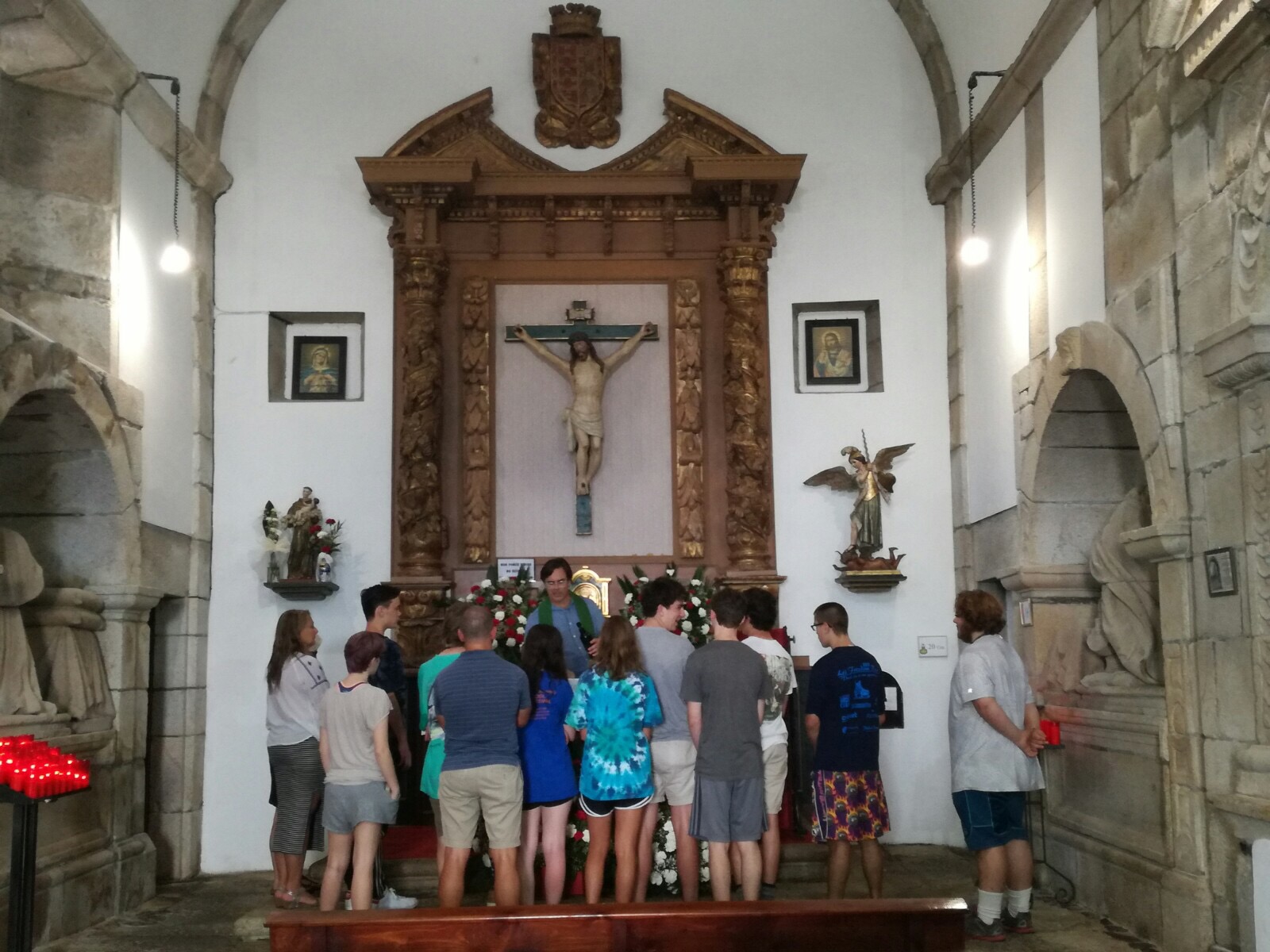
Walking across the Camino de Santiago with 10 teenagers and 3 youth leaders was  spiritual,  but it was also pretty religious as well. We read scripture, shared communion in an ancient cathedral, prayed  morning, noon, evening and compline prayers, and shared the experience of a holy pilgrimage with thousands of others from across the globe.

Every year,  pilgrimage offers a “mountain top” religious experience for our teens that grows out of  religion that does not judge them or put  psychological pressure on them. Already marked as “Christ’s own forever” through the waters of baptism, they simply get even more confirmation for who they already are as beloved children of God. 
We were allowed to celebrate Holy Eucharist
 in a chapel of the Cathedral in Amenal

The same could be said about their time spent at All Saints’ and being a part of a community centered with common prayer and the Holy Eucharist and ministry to the world.

No matter where we are in our lives, our emotional state, or even our faith, we pray- together. We learned while taking thousands of steps  on the Camino that common prayer embodies for us all a life facing towards God at whatever pace we are able to move.

In youth ministry (and all ministry, for that matter) we can see anew  and joyously embrace the beautiful life of faith we are offered in the Episcopal Church. On the Camino, and here at home, we experience a life changed by a self-giving, risen Lord through our common prayer.

What a singular blessing it is  to be together in the life-giving, joyful work of prayer and pilgrimage and the Church! The work that we do here as “common pray-ers” changes the lives of these teens, and radiates out to change, repair, and restore God’s kingdom. 

Shalom,


Tim

Thursday, May 25, 2017

LIFE TO THE FULLEST

LIFE TO THE FULLEST

Choking through our sobs, Patricia and I bid Madeline, our oldest daughter,  goodbye in front of her student apartment building in New York . At the last moment I lay my hands on her shoulders and blessing her and praying for her safety, happiness and wisdom. I get choked up thinking about it now, actually.Corny and embarrassing, but it was the best I could do in the moment. One last prayer for our baby, our oldest, our sweet girl, as she left the nest.  

Jesus’s  prayer in John 17 seems as if  he is trying to get one last prayer in for the people he loves. What I especially love about the prayer is that it is the same prayer we pray for our loved ones- especially those of us who have children.  Jesus wants the best life for his followers- his children. Jesus says, in verse two, “And this is eternal life, that they may know you, the only true God, and Jesus Christ whom you have sent.” The most common interpretation of the words “eternal life” is to relate it to some kind of afterlife. All throughout John, though, “eternal life” is meant to be read as “life to the fullest.” 

Jesus wants wants us to life to the fullest through him and with him right now! Brian McLaren, a writer I like a lot, says in his book, The Secret Message of Jesus that this life “a life that is radically different from the way people are living these days, a life that is full and overflowing, a higher life that is centered in an interactive relationship with God and with Jesus. Let’s render it simply an extraordinary life to the full centered in a relationship with God.” 

Jesus doesn’t want to save us from the world by granting us access to some kind of eternal life on streets paved with gold. Even better, Jesus wants us to have life to the fullest through his way- a way that lives from the the reality of a self-giving love that sits at the center of all things.

Wednesday, May 17, 2017

MEET JOEL SMITH!!! NEW LAY ASSISTANT FOR YOUTH MINISTRY AND STUFF!

Ed. Note-- Joel will be joining us August 1st as a Lay Minister for Youth. He will be focusing on small groups out in the community that we are planning for this year, service Saturdays, and increasing our presence "out there" with all of you. He will also be with us on other days at church, too. We are so excited to have him as a part of our staff and youth ministries team.

I asked him to introduce himself to all of you for this week's email message.
Peace--Tim+

Hello, everyone!
My name is Joel Smith and I am the new lay youth minister at All Saints. I’m very excited to return to the Atlanta area after I spent the last two years in Athens in the automotive program at
Athens Technical College. I was intent on finishing that program and diving head first into the workforce as a mechanic. However, upon finishing up at Athens Tech, I didn’t feel that I was making the right decision concerning vocation. I spent some time discerning what I felt called to do, and after some serious thought, I felt that I needed to devote my time and energy to the Episcopal Church.
Working in the Episcopal church is nothing new to me. I was a devout youth group attendee at St. Aidan’s Episcopal Church in Alpharetta, where I also helped on the breakfast team and worked as an acolyte and an usher. Along with my new position as lay youth minister, I am on Summer Staff at Camp Mikell, which is the camp of the Diocese of Atlanta. I’ve been going to Camp Mikell since 2006 and I really encourage you to make a trip up there as well.
Father Tim and I have been busy as can be planning awesome activities for all the youths including, but not limited to, bible studies, Camp Mikell retreats, super awesome days of fun with St. Luke’s, and service Saturdays! We’ve got some great things planned so be sure to keep an eye out for updates.
Now, a little more about me. I love all kinds of music, cars, reading, the great outdoors, and sometimes I even like the great indoors. (Oh, and also Go Falcons and Go Braves). The Episcopal Church was an extremely important and formative aspect of my youth, and I hope that it can do the same things for you that has done for me. I can’t wait to meet all of y’all!

The Peace of the Lord be always with you.
Joel Smith

Wednesday, May 10, 2017

The Waze of the Father

And if I go and prepare a place for you, I will come again and will take you to myself, so that where I am, there you may be also. And you know the way to the place where I am going.” Thomas said to him, “Lord, we do not know where you are going. How can we know the way?” Jesus said to him, “I am the way, and the truth, and the life. No one comes to the Father except through me. If you know me, you will know my Father also. From now on you do know him and have seen him.” John 14:5-6


Neighborhood streets in Atlanta are clogged with traffic like never before. As a result, people are hacking the popular mapping application, Waze, by telling it that there is traffic on their streets so it will not route people through their neighborhoods. Waze works well because it gets updates from users. The maps themselves are good, but people cannot find the best way anymore. The "users" are messing up "the way."

Thomas needs a map. He and the other disciples are feeling lost and confused in the days following Jesus’ death and resurrection.Thomas is a literal thinker, because he thinks that Jesus is talking about going down the road, or to another country, and he wants to know the way to get there so he can be with Jesus. The only “map” that exists, Jesus tells him, is to follow the path that Jesus has walked- loving others, welcoming the outsider, forgiving, healing and restoring the world. I still think Thomas must have been confused even after Jesus tried to set him right. Humanity has continued in its confusion as well.

Our “maps” towards Jesus are often no good, or at the very least confusing. The "users" - Christians- do well at messing up the way sometimes. All kinds of things are labeled as Christian when they are really just hate or fear for the other. Being who we are does not mean that everyone else not like us is wrong, or lost. Being who we are means that the end result of our faith practices should be lives that look like Jesus- lives of self-giving love like God has for us. Our “map” is our prayers and way of life and if it takes us down a path that leads towards violence, anxiety, fear and distrust of the other, it is probably no good. We are still lost, because Jesus is somewhere else. 

A life spent pursuing the way of Jesus may not be perfect or without doubt or hardship or confusion. Jesus does tell us  that any life lived with love and compassion, however imperfect it may be, leads toward home. Jesus has shown us the way- now we are called not only to follow it home but to be with him during the journey. 


Thursday, May 4, 2017

God's Wasteful Love For Us

Jesus used this figure of speech with them, but they did not understand what he was saying to them. So again Jesus said to them, “Very truly, I tell you, I am the gate for the sheep. All who came before me are thieves and bandits; but the sheep did not listen to them. I am the gate. Whoever enters by me will be saved, and will come in and go out and find pasture. The thief comes only to steal and kill and destroy. I came that they may have life, and have it abundantly.” John 10:6-10


My Dad has a lot of great sayings on his office wall. My favorite is, “Live fully, love wastefully, and have the courage to be yourself.”

God loves us “wastefully” or with an abundance beyond the limits of our conception. 
.
Even hen Jesus tries to describe God’s wasteful love by using overly-familiar images of temple, sheep gate, shepherd and sheep his followers  “ … did not understand what he was saying to them.”  (Jn 10:6)  In the midst of the harsh realities of their lives in the ancient world, I imagine it was easier to believe in a violent and vengeful God than the one Jesus is describing. In the end, he has to spell it out for them and give them the definitive good news that “I came that they may have life, and have it abundantly” (Jn 10:10).

Our lives sometimes make it hard to see, but Jesus reminds us God’s love is  huge and obvious as the temple, humble and gentle like a sheep, guiding us like a shepherd, and safely leading us to holiness through the “gate” that is communion with his love for us.  


Jesus is shepherd, gate, and sheep rolled into one. He is self-giving, guiding, saving love made plain for all humanity. Abundant life- being truly human- is found not in “killing and destroying” but in constantly orienting our lives (with God’s help) towards self-sacrifice, humility and compassion for ourselves, others, and the world.